
One of the most elusive secrets of the Mu-Tron III is the part labeled on the schematic as “805A.” It’s the heart and soul of every Mu-Tron III, a dual LDR with an LED shining at it. Its normal identifier is a black box or black tube, with four leads on one end, and two leads on the other. But, depending on who made the pedal (Musitronics or ARP) and when, you might find some different optos inside your vintage Mu-Tron. If you find a different one than any I have pictured below, feel free to email it to me, i’d love to add it to this blog post.
Nothing like this component exists today. You can find opto’s for other optical based pedals no problem such as the NSL-32 or VTL5C3, but they are single LDRs with single LED’s shining at them.
The Musitronics 805a version seems to have been manufactured by Hamamatsu based on the arrow marking on the part. Hamamatsu also made other dual optos, such as the P873-13, and the rare P873-14 (which to my ears, is what was in the ARP Mutron). I have a stock of P873-14’s, but combing through old catalogs, i’ve never been able to find them actually having been for sale.
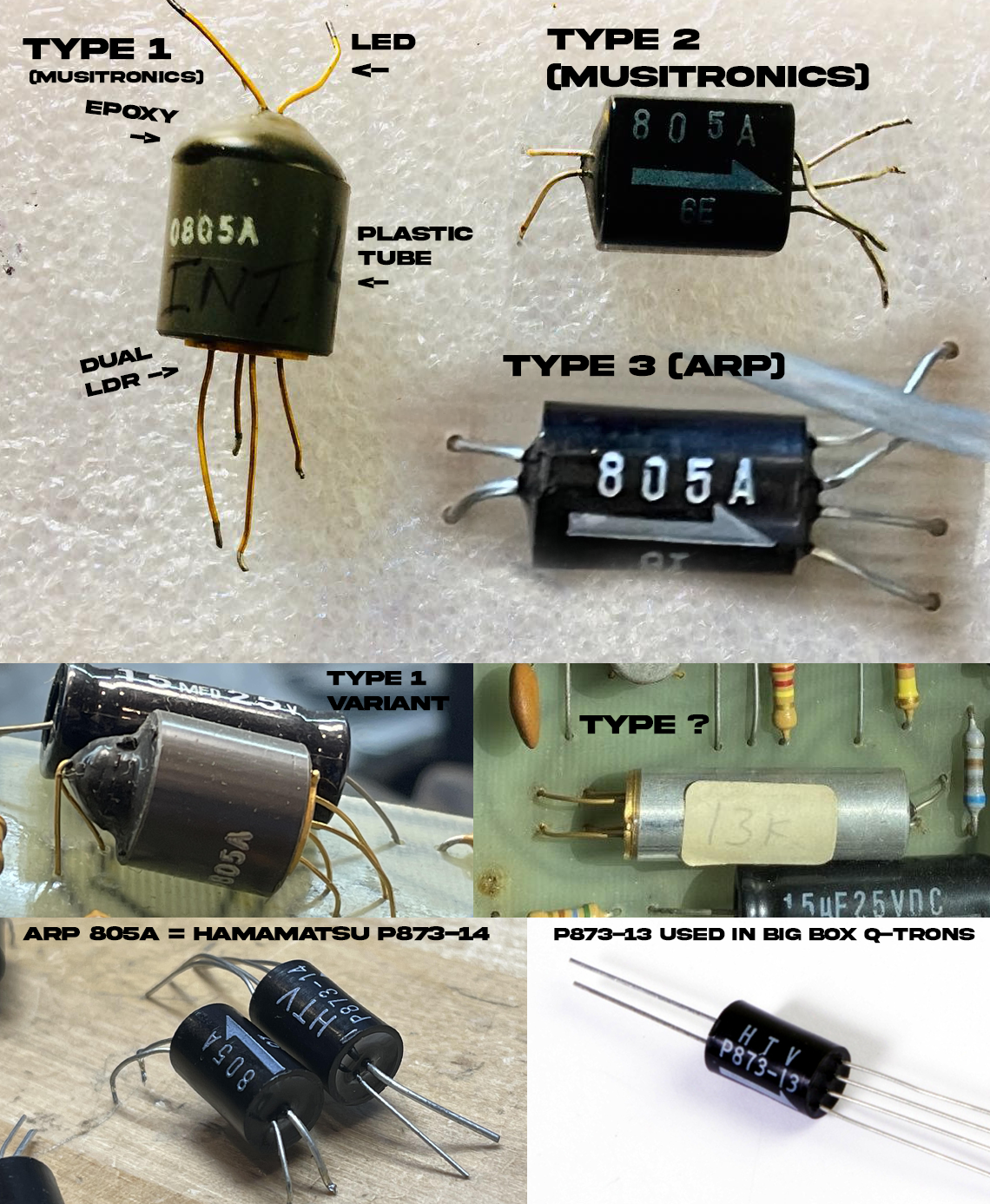
What if I want to make a MuTron III opto from scratch? Or replace a confirmed failed dual opto?
In order to use individual optos, like the NSL-32, you need to put the LED’s in series. This presents a problem: a higher forward voltage to overcome, therefore changing the characteristics of the pedal. I don’t recommend replacing an 0805 with two individual optos for this reason.
With some careful work, you can create your own homebrew opto that will sound and perform much closer to the vintage 805a.
Advanced Photonix makes some incredible LDR’s with similar characteristics to the human eye. You are shooting for 10M OFF resistance (No LED shining on it) and approximately 10k ON resistance (LED shining at it). You can use datasheets to confirm the part you selected is close.
I’d recommend buying 10 or so, and create a test setup to match LDR’s. This is simple enough to do with a multimeter measuring resistance, and a small LED shining at it from the same length every time, in a dark room. This will give you a rough idea of their on and off resistance, and allow you to choose two that are closely matched.
My suggestion is to use a small tube to create an enclosure, putting an LED in one side, and the two LDR’s in the other. Use black epoxy to seal it and check there are no light leaks by powering the opto in a dark room. Verify the function by measuring the resistance of each LDR when powering the LED. They should be pretty close as you increase and decrease the voltage.
This will allow you to create the most accurate homebrew version of the 805a.
My MuTron/QTron opto has failed! What do I do?
If you have an existing MuTron or Q-Tron with a failed dual opto, do not fret before you test it. It’s likely the LED has simply failed. You can verify this with a multimeter on the diode setting. My recommendation would be cutting it open, extracting the dual LDR element, and testing it for proper On/Off resistance. Get a new LED (select the same color as the failed one), and create a small enclosure to stuff the LED on one side and dual LDR element in on the other. I’ve been able to achieve this with a 3D printer and black epoxy to revive old dual optos.
What more do we know?
Combing through Hamamatsu catalogs has shown me the P873-13 was the only dual opto they ever officially sold to the public. Musitronics must have had a contract with Hamamatsu to create the 805a we see in vintage pedals today.
Hamamatsu also made a dual LDR that has similar specs to what we are looking for, the P1109, but i’ve never been able to find one for sale online.
Based on this evidence, I can conclude the P1109 was likely the dual LDR Musitronics used in early “Type 1” style enclosures, where the 805a obviously has four leads protruding from a metal can base. These had an ON resistance of approximately 15k, so these versions may sound different than the later, square, boxy 805a’s. In one of the images above, you can see someone labeled (what I believe is) the ON resistance of the dual LDR as 13k, so there may have been some variation there.